
June 2026 Visa Bulletin: Who Moved Forward, Who Got Stuck, and What to Do Now
India's EB-1 and EB-2 retrogressed this month while family categories moved forward. See who can file now — and which documents to prepare before your priority date moves.
 Written by
 Short answer: The June 2026 Visa Bulletin brings a mix of significant movement and disappointing setbacks. While family-sponsored categories largely advanced, the EB-2 India retrogression was the headline for professionals, with dates moving back nearly a decade. For your adjustment of status filing this month, USCIS confirmed that employment-based applicants must use the Final Action Dates chart, whereas family-sponsored applicants are permitted to use the more favorable Dates for Filing chart. If your priority date is current, we recommend filing immediately before further shifts occur.
Key takeaways
Major EB-2 India retrogression: EB-1 India moved back to December 15, 2022, and the EB-2 India retrogression pushed dates back to September 1, 2013, under the Final Action Dates chart.
Family categories show momentum: F2A continued to advance; consult the official U.S. Department of State Visa Bulletin for specific country cutoffs.
USCIS chart selection: As per the USCIS filing charts page, family-sponsored applicants use Dates for Filing in June 2026, while employment-based filers are restricted to Final Action Dates.
What the Visa Bulletin is — and why two charts matter
The U.S. Department of State publishes the Visa Bulletin every month, and it guides millions of people who are pursuing or planning to pursue a green card. It exists because U.S. immigration law caps how many green cards can be issued each year — roughly 226,000 for family-sponsored preference categories and 140,000 for employment-based preference categories, plus an unlimited number for immediate relatives of U.S. citizens. When demand in a category exceeds the annual supply, a waiting line forms, and the Visa Bulletin tells you where the line currently stands.
Your place in line is your priority date — the date your relative or employer filed the underlying petition (Form I-130 or I-140) on your behalf. Each month the bulletin publishes two charts per category:
- Final Action Dates — the date on which a green card can actually be approved and issued.
- Dates for Filing — the earlier date on which you may submit your application package, even if it can't be approved yet.
Each month, USCIS announces separately which chart adjustment of status applicants may use. For June 2026, USCIS determined that all family-sponsored preference applicants use the Dates for Filing chart, and all employment-based preference applicants use the Final Action Dates chart. That makes June a more flexible month for family-based filers and a more restrictive one for employment-based filers.
Employment-based movement in the June 2026 Visa Bulletin
The headline this month is India. EB-1 and EB-2 India both retrogressed under the Final Action Dates chart — the chart that governs employment-based adjustment filings in June. Here is how the major categories landed:
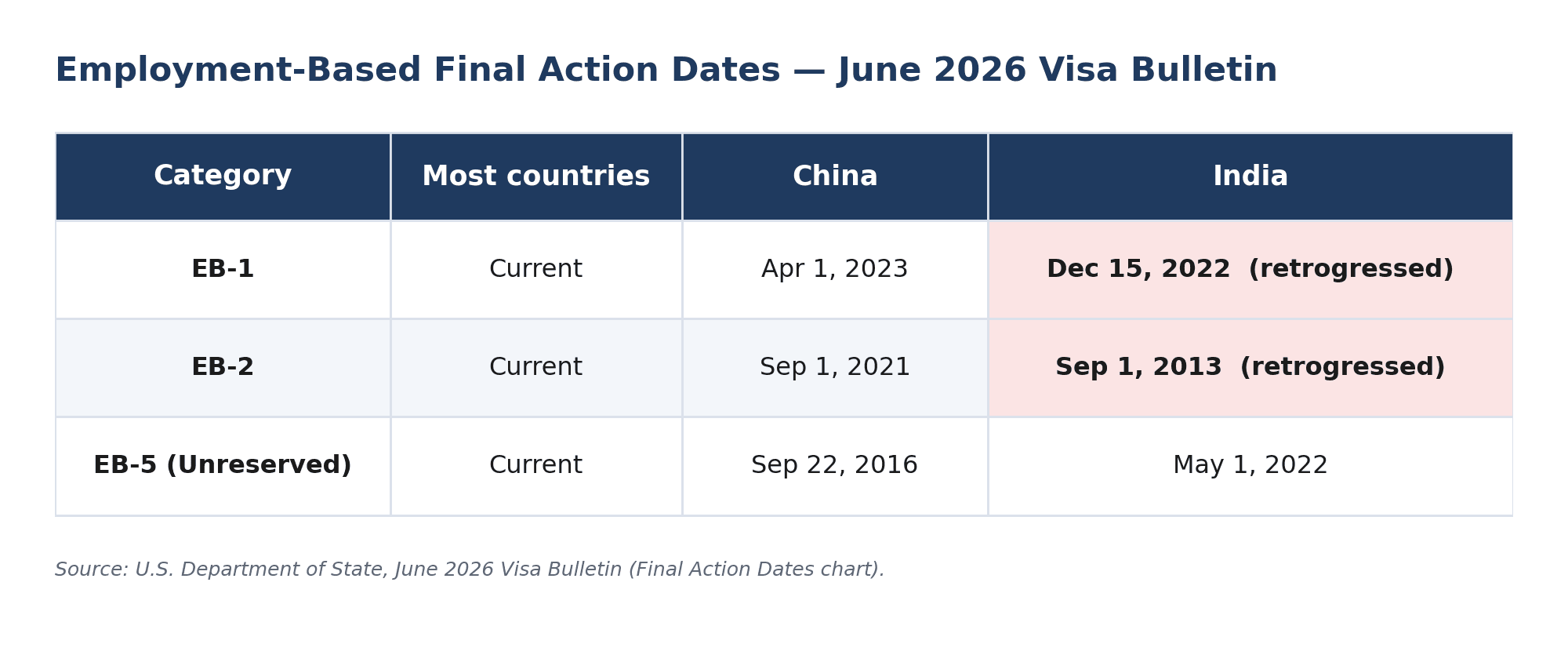
EB-5 set-aside categories (rural, high-unemployment, and infrastructure) remained current for all countries. The EB-4 category for certain religious workers was renewed through September 30, 2026; if Congress does not renew it again after that, it would become unavailable. For categories and countries not listed above, consult the full bulletin directly, since movement varies.
The EB-2 India retrogression is the most consequential change. A cutoff date of September 1, 2013 means that, this month, only EB-2 India applicants whose petitions were filed before that date can have a green card finally approved — a reminder of how long the employment-based backlog for India remains.
Family-sponsored movement
Because family-sponsored adjustment filers use the Dates for Filing chart in June, the practical news is more encouraging. The standout is F2A — the category for spouses and unmarried children under 21 of lawful permanent residents — whose Dates for Filing cutoff is listed as current for all countries, meaning eligible F2A applicants can file regardless of priority date. On the Final Action Dates chart, F2A advanced roughly five months in a single bulletin, jumping to January 1, 2025 for most countries. F2B advanced for most countries as well, while F1 (unmarried adult sons and daughters of U.S. citizens) saw no movement this month.
What to do now if your date is current
A current priority date is a window, and windows close. The June bulletin explicitly cautions that further retrogression may be necessary in some categories as soon as next month. The prudent reading, especially for applicants in categories that are current or close to it, is to file while eligible rather than assume the same dates will be available later in the fiscal year.
Filing an adjustment of status package, or moving forward with consular processing, means assembling a complete document set — and that is where cases most often lose time. In our experience preparing certified translations for green card filings, the month a priority date becomes current is exactly when document gaps surface: a foreign birth certificate with a name spelled differently than on the passport, a marriage certificate in another language with no translation attached, or a police certificate whose issuing authority is missing from the English version. Each of those can trigger a Request for Evidence weeks later and push a filing into a month when the date may no longer be current.
The fix is to have your civil documents — birth, marriage, divorce, police, and court records — translated and certified before your date becomes current, so the package is ready to file the moment the bulletin moves in your favor.
ImmiTranslate provides certified translations of immigration documents that meet USCIS and U.S. Department of State requirements, accepted for adjustment of status and consular processing. If you are watching the Visa Bulletin for your category, having your documents translated and certification-ready is the one preparation step fully within your control. Get a certified translation quote →
A note on forecasts and accuracy
Visa Bulletin movement is not fully predictable. The State Department adjusts cutoff dates monthly based on demand, visa number usage, and per-country limits, and it has publicly stated that its revised forecasting process is meant to reduce month-to-month swings. Even so, dates advance, hold, and retrogress in ways that surprise applicants and attorneys alike. Treat any prediction — including the cautions in this article — as informed estimation, not certainty, and confirm your category against the official bulletin each month. The figures here reflect the June 2026 bulletin as published; later corrections or the July bulletin may change the picture.
Frequently asked questions
Which Visa Bulletin chart do I use to file in June 2026? It depends on your category. For June 2026, USCIS determined that family-sponsored preference applicants use the Dates for Filing chart, and employment-based preference applicants use the Final Action Dates chart. Always confirm the current month's determination on the USCIS filing charts page.
What does retrogression mean? Retrogression is when a category's cutoff date moves backward instead of forward, usually because demand for visa numbers exceeded supply. When a date retrogresses, applicants who were current may no longer be able to have their case approved until the date advances again.
Why did EB-2 India retrogress in the June 2026 Visa Bulletin? EB-2 India retrogressed to September 1, 2013 because the per-country limit and heavy demand in the employment-based backlog mean visa numbers must be conserved. India faces one of the longest employment-based waits of any country.
Can I file my green card application if my priority date is current? If your priority date is earlier than the cutoff date in the chart that applies to your category this month, your turn has come and you can file. Because dates can retrogress, filing promptly when eligible is generally the safer approach.
Do I need to translate my documents before filing? Yes. Any foreign-language civil document submitted to USCIS or the Department of State must include a complete, certified English translation. Preparing these before your date becomes current avoids delays and Requests for Evidence.
About ImmiTranslate
ImmiTranslate provides certified document translations accepted by USCIS and the U.S. Department of State, supporting adjustment of status, consular processing, and naturalization filings. We work with immigration law firms and individual applicants nationwide and have completed certified translations for thousands of immigration cases. We are a corporate member of the American Translators Association (ATA).
This article is general information, not legal advice. Immigration outcomes depend on your specific visa category, status history, and individual circumstances. Consult a licensed immigration attorney about your case.
About the Author
Ian Hawes, CEO at ImmiTranslate. Ian has worked in the immigration industry for over 10 years and has been a software engineer for more than 15 years. ImmiTranslate is a certified document translation provider for immigration attorneys and applicants, and a corporate member of the American Translators Association (ATA).
Editorial Standards & Fact-Checking
This article is based on the June 2026 Visa Bulletin issued by the U.S. Department of State and the official USCIS Adjustment of Status Filing Charts.
Verification: All cutoff dates and filing instructions were cross-referenced against official government announcements from the U.S. Department of State.
Independence: This analysis is independent and not affiliated with any government agency.
Disclaimer: Immigration law is subject to rapid change. This content is for informational purposes and does not constitute legal advice. We recommend consulting with a qualified immigration attorney regarding your specific priority date and eligibility.
Blog